
The LoRA Paradox: Why 2026 is the Year of Weight‑Level Control & Quality Assurance
Training LoRA adapters is less expensive and faster, but keeping them alive in production has become an operational nightmare. Here's how weight-level controls finally close the gap.

We were promised a revolution in AI efficiency when Low Rank Adaptation (LoRA) first arrived. Instead of retraining massive models with billions of parameters, we would simply inject tiny trainable rank decomposition matrices into the transformer layers while keeping the original pre-trained weights frozen. This approach allowed us to reduce the number of trainable parameters by as much as 10,000 times. It was supposed to be the end of the era of massive GPU bills and the beginning of hyper-specialized, modular AI.
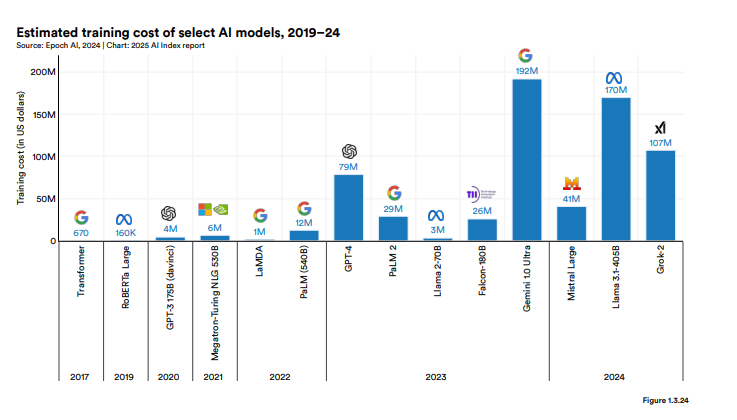
By early 2026, the data shows a more complicated and costly reality. While training these adapters is indeed cheaper and allows for fine-tuning on much more accessible hardware, keeping them alive in a production environment has become an ongoing operational nightmare. According to the Stanford HAI AI Index Report 2025, the cost of training state-of-the-art models has reached staggering new heights, with some models requiring over $100 million in compute (see Figure 1 below). While LoRA was designed to escape this financial gravity by focusing only on the change in weights, the HAI report also highlights a critical shift: the complexity of evaluating and maintaining these models is growing faster than our ability to train them.
We have entered the era of the LoRA Paradox: where the cost to build has dropped, but the cost to manage has exploded.
Beyond the Black Box
The fundamental problem is that most teams treat LoRA adapters as static files or black boxes. Because LoRA works by approximating the weight updates through two smaller matrices, teams often lose sight of the actual mathematical transformations happening inside the model. In a high-scale environment, this leads to a dangerous lack of visibility.
The HAI data indicates that as models become more specialized, the evaluation gap widens even further. Traditional benchmarks can no longer tell us why a model is failing in the real world. When a model starts providing poor answers, it is nearly impossible to tell if the flaw exists in the foundational base model or the specific adapter matrices sitting on top of it.
The Authentrics Approach: From Black Box to Serviceable Asset
At Authentrics.ai, we believe AI needs to move from being a disposable artifact to a serviceable corporate asset. Our Machine Learning Resilience Infrastructure (MRI) provides powerful measure and intervention capabilities. Unlike standard observability platforms that only monitor inputs and outputs, MRI operates at the tensor layer, accessible through existing model versions and checkpoints, providing an independent framework to monitor the mathematical health of the model itself.
Four Weight-Level Control Tools
To solve the challenges of modern AI deployment, Authentrics provides four specialized tools that function directly at the LoRA weight and checkpoint level:
1. Training Session Influence Mapping
Map specific behaviors back to the original training data, providing a clear audit trail. When a model exhibits a specific bias, you no longer have to guess which data points caused it.
2. Neuron-Resolved Training Impact Analysis
Quantify exactly which data drives specific results. Understand the reason behind model performance without expensive trial-and-error cycles.
3. Direct Weight-Level Model Editing
Undo previous training sessions throughout a model history, allowing repairs without traditional rollbacks or the risk of regression. If a specific training run introduced a flaw, you can simply edit it out.
4. Direct Weight-Level Behavior Steering
Optimize model direction without a single new training run. Using Z-TOM technology, teams can "autotune" checkpoints to optimize behavior in real time.
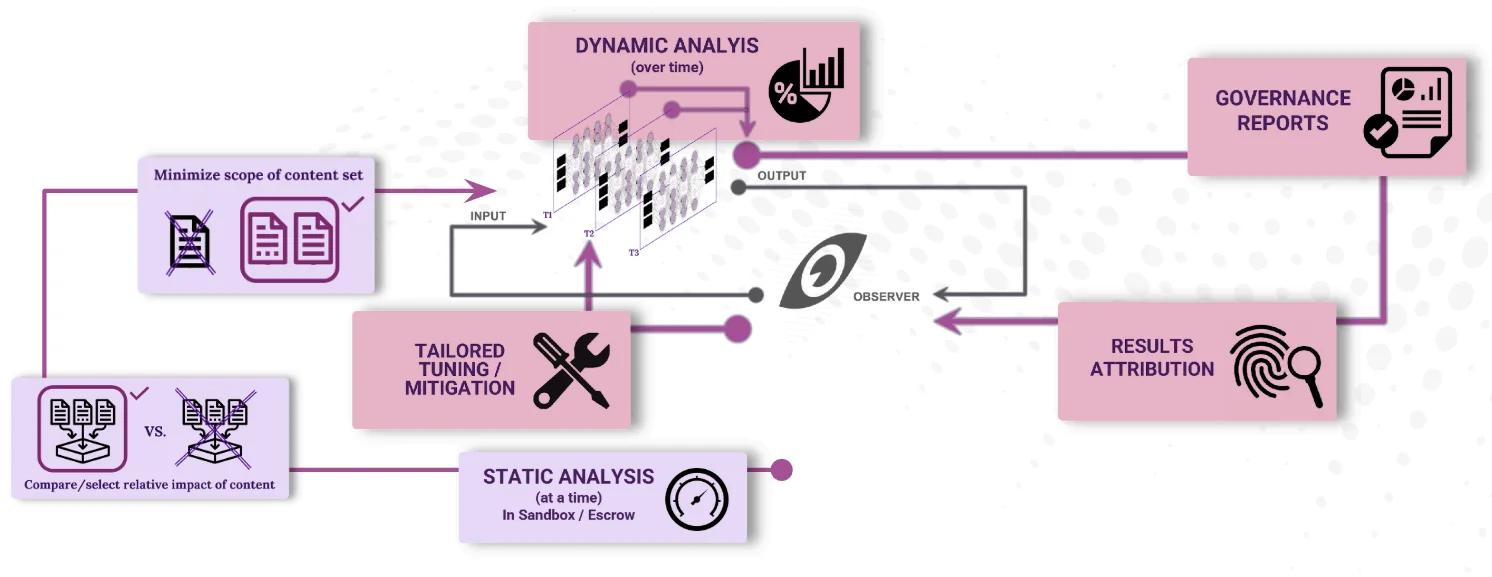
In Figure 2 above we visualize how the Authentrics.ai toolset can integrate into a standard AI/ML pipeline. Additional technical demonstrations can be found through our public documentation, where practitioners can browse several additional notebooks that walk through the core toolsets above.
Driving Measurable Value Across the Business
Once the Authentrics toolset is integrated into the AI/ML pipeline, the operational friction of managing dozens, or even hundreds, of LoRA adapters begins to evaporate. This shift is critical as we move into the era of Agentic AI and Small Language Models (SLMs). In 2026, the industry has pivoted away from monolithic models in favor of agent swarms where each specific task relies on a highly specialized LoRA adapter. Without weight-level governance, these agentic workflows become brittle and impossible to debug.
For the Practitioner
Diagnose specific weight updates causing deviation in minutes. Ship specialized agents 3× faster than traditional methods.
For the Head of AI
Cut total cost of ownership by up to 90% by shifting from high-cost training clusters to efficient inference-level steering.
For the Head of Quality
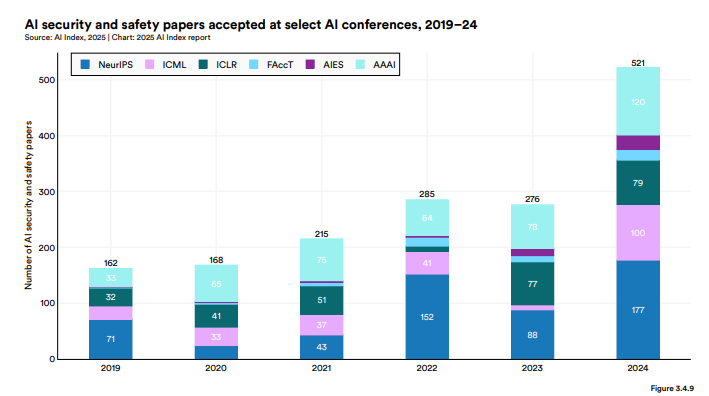
100% transparent audit trail from the weight level back to the training data. Mathematically prove model integrity for finance, defense, and healthcare compliance. Figure 3 below highlights the increase in concern for AI, visualized through paper submissions on AI safety.
The Future of Model Life Cycles
For too long, the industry has accepted a broken lifecycle for fine-tuned models. The old way is a straight line to failure: spend weeks training an adapter, push it to production, then watch it slowly drift until it eventually breaks. Authentrics changes this dynamic by turning it into a circular and iterative process: train, observe, and surgically improve what you already have.
Imagine running a fleet of specialized medical agents. With Authentrics, instead of guessing why a model is failing, your team sees the weight drift at the tensor layer weeks before it becomes a problem. A quick checkpoint edit or steering adjustment fixes the model in minutes for less than $100 in compute, saving 99% of recovery costs while handing auditors a complete map of model behavior.
Conclusion
The industry shift toward agentic workflows and specialized adapters has created a critical need for transparency that traditional black-box training methods cannot provide. Authentrics restores fundamental explainability between training data and results by operating directly at the tensor layer. By utilizing our Machine Learning Resilience Infrastructure, practitioners gain unprecedented control over the fine-tuning of open-weight models, allowing sparse weight-manifold interventions to achieve state-steering without the stochastic noise of gradient descent.
In short, we deliver explainable, controllable, and cost-effective AI/ML Ops to drive your mission- or business-critical AI projects.